Research explores the impact of dog-assisted activities on school children’s stress levels over a school term.
For many children, their school years will not be the best years of their life. With mounting academic expectations, the long shadow cast by Covid-19, and constant pressure of social media, it’s perhaps not surprising that record numbers of children are chronically stressed.
To tackle this growing issue, schools are increasingly on the lookout for programs to help reduce children’s stress levels. One such intervention, using dog-assisted activities, has been the focus of a recent study, showing that man’s best friend may also be a child’s best hope for combatting classroom stress.
New research into the effects of dogs
The research incorporated two studies, one which included 105 children from mainstream schools and another which included 44 children with special educational needs. The children, aged between 8-11 years, were randomly assigned into three groups: dog intervention, relaxation intervention, and no treatment.
Children in the intervention groups participated in the activities for 20 minutes, twice a week, over a school term, both individually and as small groups. Children in the no treatment group carried on with their classes as normal.
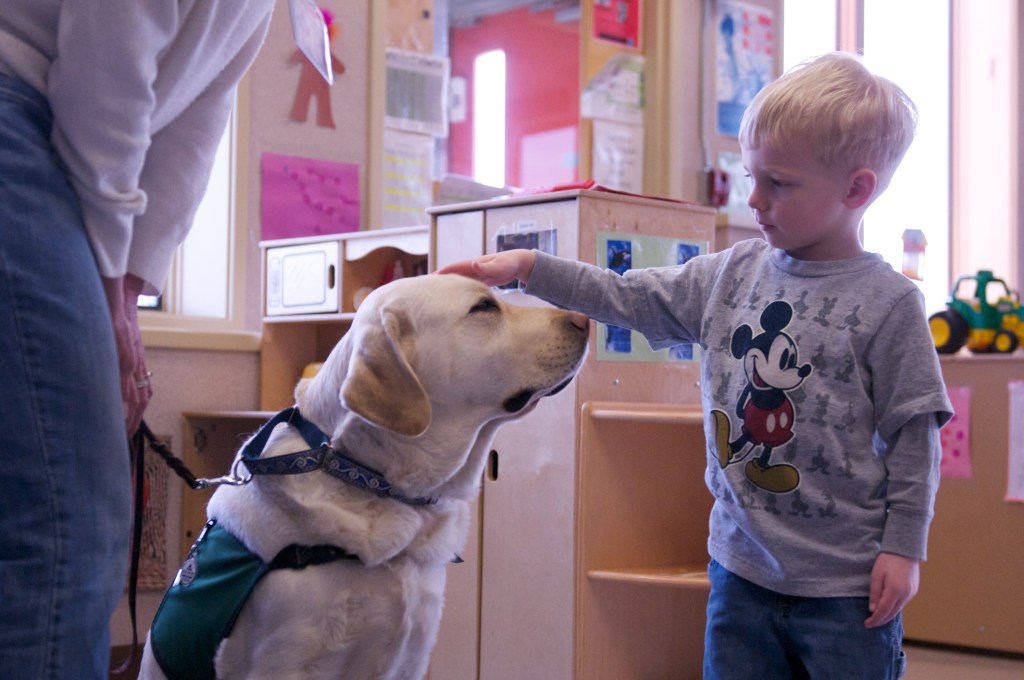
In the dog intervention, children interacted with a dog and their handler, performing activities such as stroking the dog. In the relaxation intervention, children took part in active and quiet relaxation activities, such as wiggling their toes.
In all groups, saliva samples were collected to detect physiological changes in a biomarker for stress, cortisol.
Stress reduction after dog intervention
The results revealed that children, with and without special educational needs, enjoyed a significant reduction in their cortisol levels after the dog intervention, compared to their peers in the relaxation intervention and no treatment groups.
The baseline cortisol levels for neurotypical children in the dog intervention group also did not increase over the school term, in the same way they did for children in the relaxation intervention and no treatment groups.
However, the cortisol levels of children with special educational needs only reduced in the dog intervention group sessions, prompting further investigation into the differential pattern of results observed between individual and group sessions.
One possibility is that children with diagnoses like autism spectrum disorder found the one-to-one sessions more socially intense. Or, that the dog’s presence during group sessions was able to facilitate interactions between people.
Future integration into education
By using a randomised controlled trial design, the study provides strong evidence that dog-assisted activities can reduce physiological biomarkers of stress in children in an educational setting.
As schools continue to search for ways to improve the wellbeing of their students, the results of this study demonstrate that dog interventions provide a feasible and effective way to reduce stress in children, with and without special educational needs.
However, further research is needed to better understand how to maximise the benefits for different populations.
Key study findings:
- Children with and without special educational needs experienced a reduction in cortisol levels after the dog intervention
- Neurotypical children’s stress levels did not increase over the school term in the dog intervention group
- The cortisol levels of children with special educational needs only reduced in the dog intervention group sessions

 The Power of Pets