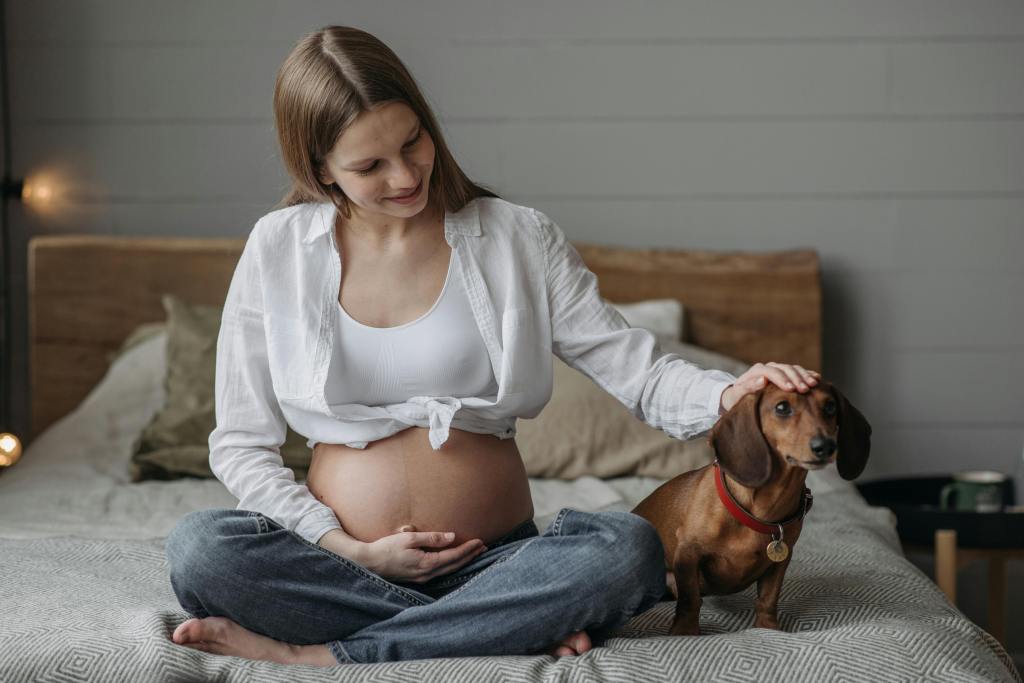
New research reveals that almost two-thirds of pregnant dog owners notice behavioural changes in their dogs.
Anecdotally, dog owners around the world have pointed to changes in their dogs’ behaviour after getting pregnant, with many noting that they became more clingy and protective towards them. Yet until recently, no scientific efforts had been made to understand the prevalence of these behavioural changes, and whether any owner or dog factors predicted them.
A study, conducted by researchers from Queen’s University Belfast and Dalhousie University, included 130 participants who owned a dog when they became pregnant. All participants completed an online questionnaire, which asked about dog/owner demographics, the owner’s pregnancy, their dog’s behaviour before and during their pregnancy, as well as the dog-owner relationship.
New focus on an old mystery
What their results revealed was that 65.4% of dog owners, almost two-thirds of participants, noticed changes in their dogs’ behaviour when they became pregnant. The most frequently reported behavioural change was an increase in attention-seeking behaviours, like cuddling up to their owner or sniffing them.
This was followed by an increase in guarding behaviours, such as growling or moving in-between people. It was most prevalent with unfamiliar individuals, although a smaller percentage also reported it around familiar people. Factors which best predicted a change in dog behaviour were pre-existing guarding behaviours and not experiencing fear/anxiety towards other dogs.
The science of pregnancy
Pregnancy has a massive impact on a woman’s body, causing hormonal and metabolic shifts that can change their body odour. With their incredible sense of smell, it’s likely that dogs are able to pick up on these early pregnancy clues, although that doesn’t mean that they necessarily understand their owner is pregnant.
However, it’s also possible, considering dogs’ sensitivity to human behaviour, that they aren’t responding to the women’s physiological changes, but behavioural ones. Previous research has shown that dogs can use their owners’ behaviour to guide their own, known as social referencing. Therefore, their dogs may be responding to changes in their owners’ behaviour, before they even noticed the change themselves.
Future research
One of the biggest limitations of this study is that it relied on owners’ perceptions and recollections of their dog’s behaviour whilst they were pregnant, which may not be accurate. When we remember things, it’s not like watching a film playback in our head, instead have to recreate it, which leaves it open to being reshaped by information that we learned later.
For this reason, future research should seek to capture more objective measures of dog behaviour, such as video recordings or activity trackers. Also, more research is needed to fully understand how dog temperament may predispose them to experiencing behavioural changes when their owner is pregnant, which seems to suggest that dogs with more stable temperaments are at increased risk, and the mechanisms which underpin this.
Key study findings:
- Almost two-thirds of pregnant owners reported changes in their dogs’ behaviour
- Over one-quarter noticed these changes before they realised they were pregnant
- Attention-seeking behaviours increased the most, followed by guarding behaviours

 The Power of Pets
Leave a comment